What can we learn about game design by comparing Dance Dance Revolution and Pump It Up, two nearly identical rhythm games?
Show Me Your Moves
I would wager that most people have heard of Dance Dance Revolution, an arcade game where you step on arrows in time to music. It used to be quite popular in the US during the late 90’s and early 2000’s, and the dance pad used to play the game has become something of an icon on its own.
In its heyday, DDR inspired many people to create nearly identical rhythm games. One surviving example of these games is Pump It Up. You might notice that these games look incredibly similar at a glance.
The only obvious distinction between these games is that DDR uses 4 arrows in the cardinal directions, and PIU uses 5 arrows in the corners and center. But does this difference significantly affect the gameplay experience in any way?
The Devil is in the Details
As you might have guessed, yes, the arrow placements on the dance pad actually have an enormous impact on the gameplay experience.
When Dance Dance Revolution was popular, there were many players competing with each other for the highest scores on the hardest songs. Naturally, these players studied the game and took advantage of every technique they could, whether or not these techniques were originally intended by the developers. One of these techniques is known as bracketing, where a player turns their foot at a diagonal angle and places it at the corner between one of the side arrows and one of the top or bottom arrows. This allows a player to hit two arrows at once with a single foot, saving a significant amount of energy by avoiding the need to jump and use two feet to hit the arrows together. You can get an idea of how this works with one glance at a DDR pad:
The DDR dance pad was not designed to allow bracketing, and the separation between the corners of the arrows on the dance pad makes the technique difficult to perform consistently without having huge feet. Thus, most players try to avoid bracketing unless it is absolutely necessary. Even so, it is an essential tool for DDR players at the highest level.
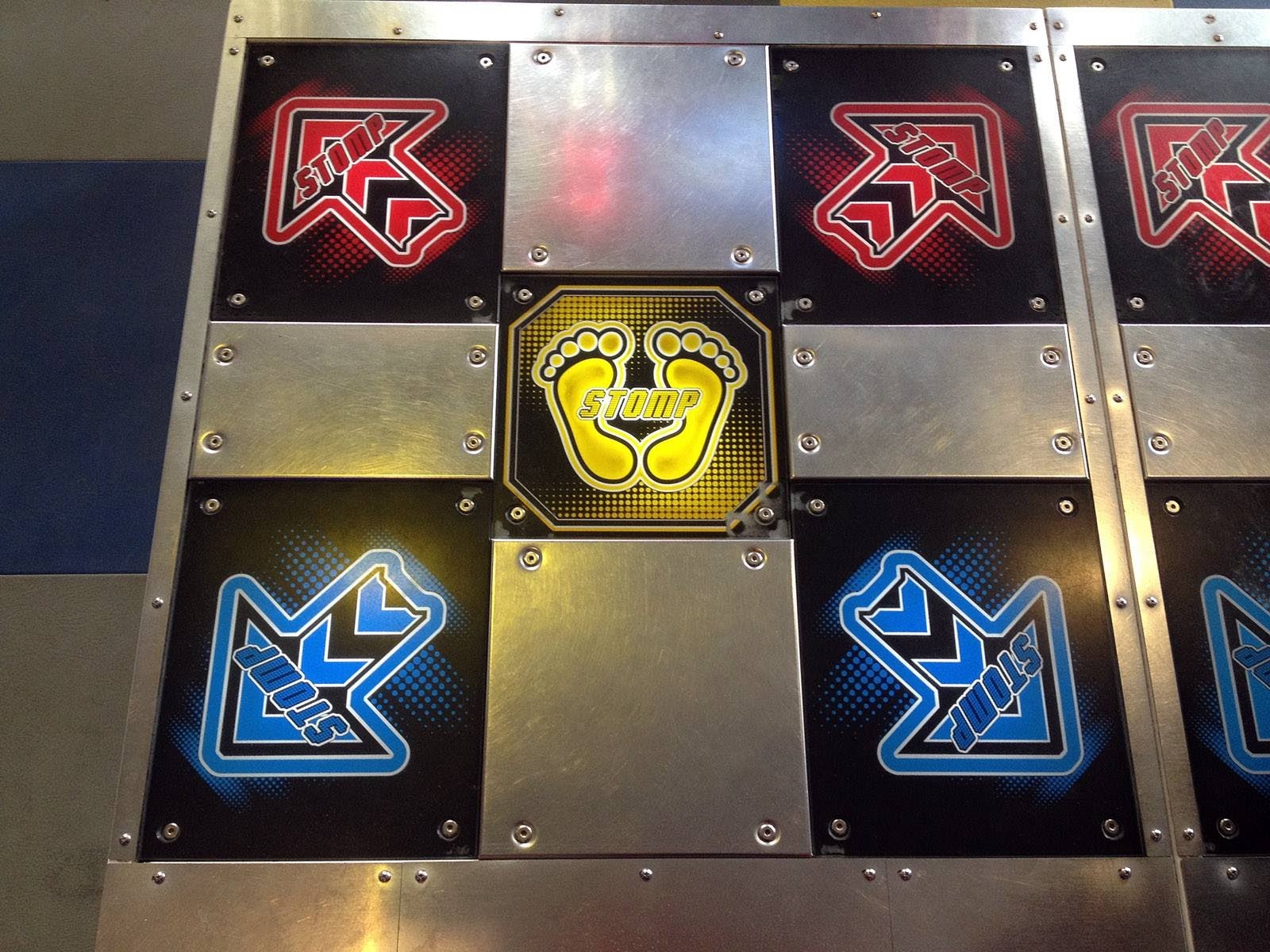
Now, take a look at the layout of the Pump It Up dance pad:
Observe how unlike the DDR pad, the PIU pad does not exactly divide the dance pad into a 3×3 grid. The corner arrows actually overlap the center row of the pad slightly, creating a small spot at each corner of the center panel where a foot turned diagonally can easily hit the center arrow plus a corner arrow simultaneously. This makes bracketing on a PIU pad far easier than on a DDR pad.
What this tells us is that Pump It Up was designed with bracketing in mind, and more importantly, PIU was designed for advanced players to exploit every technique they could to play the game. This is important to understand because this detail informs us about the motivations behind a slew of other subtle differences between DDR and PIU:
Arrow colors: In DDR, the colors of arrows on screen are based on the timing of the arrows. In PIU, the arrow colors are fixed by the type of arrow.
Failing songs: In DDR, when your life gauge depletes from missing too many arrows, the song ends immediately and awards you an E rank for failing. In PIU, the song continues to the end and awards you a grayed-out rank that would correspond to your score had you not failed.
Timing windows: In DDR, the timing required for hitting arrows is extremely strict for the best judgement ratings. In PIU, the timing is far more relaxed.
Freeze arrows/Holds: In DDR, freeze arrows require you to hold them for some amount of time, but you have some tolerance where you can let go of the arrow and press it again without dropping the freeze arrow. In PIU, holds count as a bunch of arrows in rapid succession, so releasing the hold even for a moment breaks your combo and drains your life gauge rapidly.
Overall, these changes make one thing very clear: Pump It Up was designed to challenge your footspeed and stamina in contrast with Dance Dance Revolution which was designed to challenge your timing. And once the focus is less on the exact timing of each arrow and more on the physical capability of the player to survive the song, then Pump It Up is free to introduce even more physically demanding songs than Dance Dance Revolution that push players to their absolute limits. For example, here is a video of one of the top PIU players, FEFEMZ, passing the second hardest song in the game, PARADOXX, on the hardest difficulty in the doubles mode (one player plays on two pads side-by-side). Note that he is one of only 5 people in the entire world to pass this song to date.
What can we learn?
So, what do we learn from all of this? Well, regarding DDR and PIU, we now know that DDR is a game designed to test your timing, and PIU is a game designed to test your stamina and raw speed. But on the whole, I think there are two key lessons that apply to game design at large that we can take away by comparing and contrasting DDR and PIU:
1) Small differences in games are difficult to detect at an entry skill level, but at the highest level, small differences have drastic impacts on the gameplay.
Even for players that are new to DDR and PIU, the fact that one game has 4 arrows and the other game has 5 arrows is obvious. However, the differences in the gameplay experience brought about by changes in the pad design won’t make any difference to new players. The songs these players will be able to play are not going to require advanced techniques such as bracketing, and the addition of one extra panel to keep track of will not greatly affect how successful new players are overall. Additionally, the slew of subtle differences in gameplay mentioned earlier will be nearly invisible to new players who do not have enough experience to notice such small differences. However, for players at the highest level, these changes impact the game drastically, making DDR and PIU feel like totally different games. As game designers, we should bear in mind that small tweaks to our games might not be detectable in early stages of development or when playtesting with new or inexperienced players. However, these small changes can make enormous differences for well-established, experienced players.
2) Decide on what skills to test when deciding exactly what small changes to make.
The differences between DDR and PIU are so subtle, one might imagine it would be difficult as a designer for PIU to know what changes should be made. However, I believe the key lies entirely in what skills the designers want to test in their players. PIU is designed to test players’ footspeed and stamina without worrying as much about players’ timing as DDR does. Through the lens of creating a game with this objective, it is easy to see how changes such as relaxing timing windows and letting songs finish despite failing serve PIU’s overall design.
Anyway, that’s all the wisdom I have to dispense right now. So, fellow game designers, show me your moves!
Why might games contain elements that seem diametrically opposed to their core fantasy?
A Hairy Situation
Recently, I’ve been playing a lot of Animal Crossing: New Horizons. The game provides a welcome escape from real life: during a stressful time when I am quarantined inside my apartment, I can feel free to visit a tropical island full of animal residents to befriend, bugs and fish to catch, flowers to grow, furniture to collect, and more. In my mind, it seems obvious that this game is designed for escapism—it’s a real-time life sim that maximizes the relaxation factor.
That is, until I’m suddenly attacked by wasps, tarantulas, or scorpions.
When I’m fully immersed in the bliss of virtual island life, an assault by these aggressive arthropods feels like getting jumpscared by Freddy Krueger while waiting to meet a princess at Disney World. Even if getting stung or bitten doesn’t have any truly significant consequences in-game, the game still exploits my survival instincts to deliver pure terror that interrupts the dreamlike peace that otherwise permeates every corner of the game.
So, I pose the question: if Animal Crossing is supposed to be a game for escapism and relaxation, why include something so diametrically opposed to this core purpose in the game at all?
Animal Crossing’s History
Animal Crossing: New Horizons is my first Animal Crossing game, so naturally, I first pondered this question without considering the previous games in the series. From this perspective, I couldn’t come up with any answers to my question. It seemed like a cruel joke to at the player’s expense to assault them with real and dangerous creatures, which many people are afraid of in real life, while the player tries to escape real life sources of stress and anxiety.
But then I started investigating the older Animal Crossing games, and I noticed a curious trend. Many elements of those games were specifically designed to punish and stress out players for treating the game like a game and not like real life. In the original Animal Crossing on the GameCube, Mr. Resetti punishes the player by berating them and ranting for literal minutes when the player quits the game without saving. In every game, weeds take over the town when the player doesn’t pull weeds for too long. Another staple in every game is that villagers keep track of how long it has been since the player last talked to them, and they will get upset with the player for not talking to them for too long in real time. Sometimes, villagers will even move out of the town during the player’s absence. And let’s not forget the fact that the player always owes an exorbitant debt to Tom Nook, who provides a house for the player and only demands payment afterwards.
Is Animal Crossing Really About Escapism?
As I considered all these elements of the old games, I realized that I had assumed something about Animal Crossing that wasn’t entirely true. Animal Crossing is not trying to be a game series purely for providing escapism and relaxation. The true goal of the series is to teach players how to be responsible in real life. The reason that the original Animal Crossing game was a relaxing life sim was to provide an appealing environment where players could make mistakes and learn real life lessons without the disastrous repercussions that often accompany making these same mistakes in real life. In more recent Animal Crossing games, the focus has shifted from teaching life lessons to providing escapism, but the underlying goal of the series to teach valuable life lessons is still present. That is why there are still wasps, tarantulas, and scorpions in the newest Animal Crossing game despite the fact that the game is literally about moving to a deserted island to relax.
Now, is it a good idea in general for a game to include features that work directly against the fantasy the game intends to provide? Almost certainly not. I would guess that 99 times out of 100 this would just make a game worse. However, Animal Crossing teaches us a bizarre lesson: it is possible for a game to include features that work against its core fantasy to push towards a more subtle goal that would make a less compelling game when approached directly.
If you plan to use this technique, just make sure you have a darn good reason to use it.
In Animal Crossing: New Horizons, there are balloons carrying presents that occasionally drift over the player’s island, and the player can shoot these balloons with a slingshot to retrieve their loot. The present-laden balloon is a small yet masterfully designed feature that gently pushes players to engage with most major features of the game.
The simple beauty of the balloons is that they reward the player for actively playing the game. Balloons spawn over the ocean, then slowly drift over the player’s island from one side to the other. The exact location where balloons spawn is random, and the times that they spawn appears to be random from the player’s perspective.
What this means is there is no efficient way for a player to farm balloons. Realistically, players will only find balloons if they are paying close enough attention to their surroundings while doing other business about their island. As most of the gameplay in AC:NH involves outdoor activities such as gardening, fishing, bug catching, or chopping wood, the balloons provide a small but significant extra motivation for players to go about these outdoor activities.
Making Players Earn Their Rewards
Rewarding players for actively engaging with the game is great, but an equally important part of the design of the balloons is that players must track down and pop the balloons themselves. This introduces a spontaneous sort of minigame that typically goes something like this:
While going about outdoor activities, the player discovers a balloon. They may have spotted it directly in the sky, they may have seen its shadow on the ground, or they may have heard the sound of rushing air overhead.
The player chases down the balloon, using their vaulting pole and ladder to overcome the natural obstacles of the landscape on the way.
The player finds a safe landing spot that is not over a river or in a location that is so crowded with ground cover that the present will disappear after falling.
The player lines up a shot with their slingshot and pops the balloon, dropping the present.
This minigame is so easy that there is virtually no chance that a player who has spotted a balloon will not be able to get the present. Even so, the minigame is exciting to play, and it makes the player feel like they earned their reward.
Imagine another possible implementation of these balloons: while players are going about outdoor activities on the island, balloons randomly spawn just off screen at the player’s head level, and by walking underneath the balloon, the player retrieves the present. No chase or slingshot necessary.
From the economics perspective of how frequently the player receives presents, this new system can be tuned to be virtually equivalent to the existing system. However, this doesn’t feel nearly as satisfying for the player: in their mind, it feels like the player is just being handed presents at random. This new system lacks the inherent excitement of hunting balloons. Also, this new system theoretically encourages players to partake in the same outdoor activities, but it in fact has the negative effect of encouraging players to be lazy and stand around until a balloon appears near them.
Ultimately, what this means is that the balloon system cannot be viewed in isolation simply as a mechanic to give gifts to players. It is a finely tuned component of the whole game that serves to engage the player with the rest of the game activities, and it rewards them for playing the way the game designers intended.
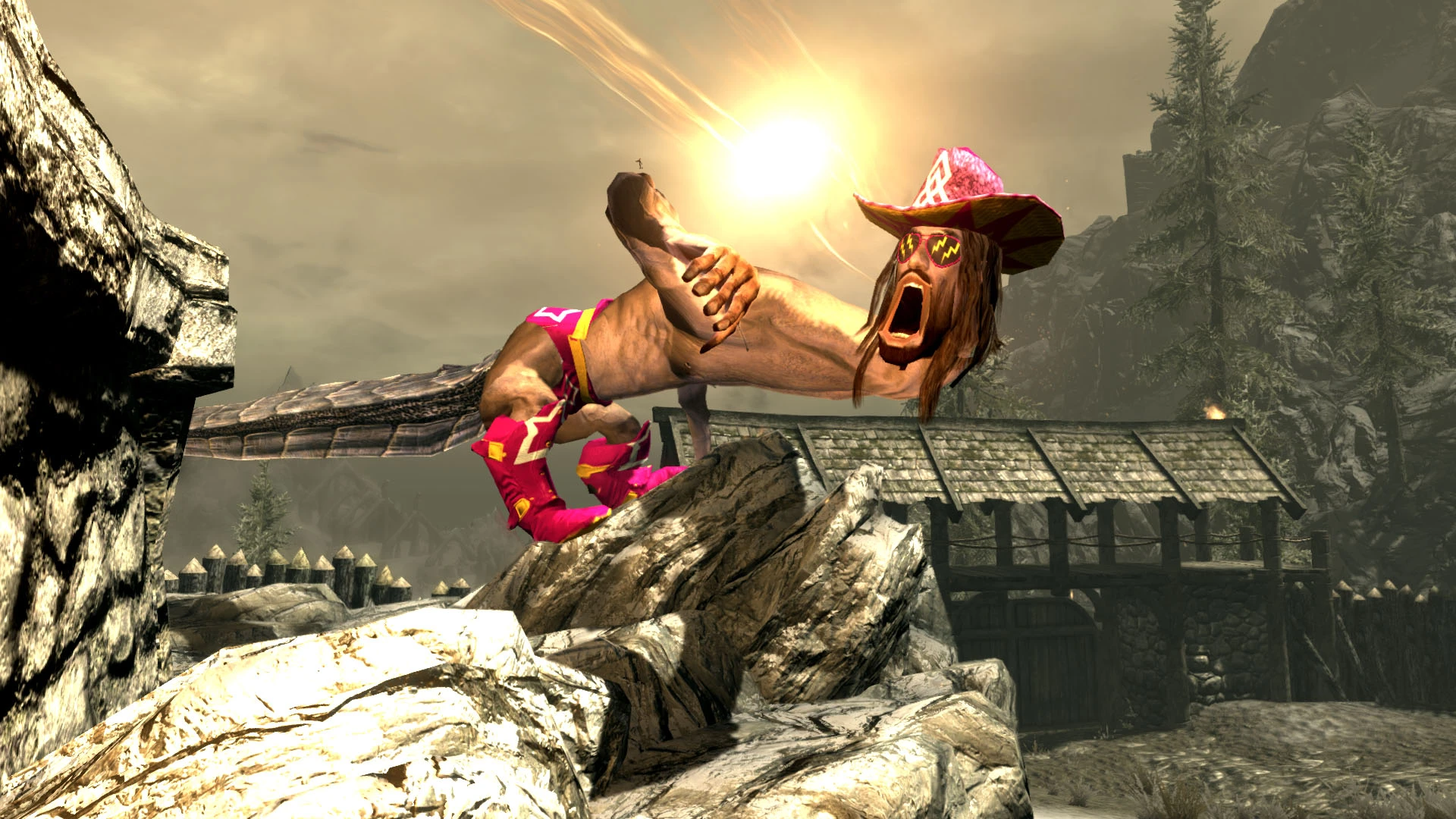
A classic and beautifully absurd Skyrim mod turns every dragon into the beloved Macho Man.
Should fans be allowed to make their own mods and fan games for video games? Where is the line between fair use and copyright infringement?
The Right to Play
Let’s do a little thought experiment. Suppose you and I decide we want to play a riveting game of Uno, the classic card game with a slight Spanish flair. We realize that neither of us own the game, so you head to a store and exchange some agreed-upon amount of money for your own copy of Uno.
You own this!
This particular physical copy of Uno now belongs to you. You own the box and the cards within the box. If you want to play a game of Uno with me, you can, since you own the game.
In fact, now that you’ve purchased it, you can do just about anything with your particular copy of Uno. If you aren’t happy about me playing a “Wild Draw 4” card, you can pick the card up in disgust and tear it to pieces. Or you can tell me that you are changing the rules, and the card now forces whoever plays it to draw four cards. I might not want to play with you anymore, but technically speaking, you’re not breaking any laws. The Fun Police aren’t going to come busting down your door for committing a crime against gaming. As long as whatever you’re doing is with your specific copy of Uno, you can do whatever you want.
The Right to Create
You can do whatever you want, that is, except reproduce and redistribute copies of Uno. Copyright laws get pretty messy, but the one thing they’re clear about is that you cannot reproduce and redistribute something that you don’t hold the rights to. For physical goods, I don’t think anyone would argue about this. If anyone could make and sell exact copies of Uno, then the people who invented the game wouldn’t benefit more from creating it than anyone else. Economically speaking, this would be a disaster, since no one would have any incentive to innovate. Everyone would wait until someone else comes up with an idea and then steal it.
Thus, copyright laws serve an undeniably important function in protecting the original creators’ rights to anything they make.
How far does this protection reach, though?
Suppose you come up with a thrilling new set of rules for Uno and post them online. Is this copyright infringement? Certainly not. You’re not redistributing the original game. In fact, your new rules might even make Uno more popular. The publisher would probably appreciate the additional publicity.
What if you make a few custom Uno cards and include them with your new rules so that people can print them out? Again, this is probably fine. People still need the base Uno game to use your additions, and you’re not redistributing the source material for the game.
Now, what if you create an entirely custom set of Uno-inspired cards that can be used without the base game and distribute them online? Is this copyright infringement? That depends. Are your custom cards just a reskin of the original Uno cards, or do they create a fundamentally different kind of game from Uno? How far from the original Uno game does your version of Uno need to be to avoid copyright infringement? And who has the authority to make a decision about this?
Unsurprisingly, the answer isn’t clear. Copyright laws are messy, and while they have good intentions and serve critical functions, they haven’t really kept up with the times. This is especially true for video games, where everything exists in the form of zeroes and ones on a cartridge, disk, hard drive, or something else.
Video Games: The Final Boss of Copyright Laws
In the digital realm of video games, what constitutes a copyright violation is rarely clear, apart from explicitly redistributing games. Passionate fans often create mods for games that add new features and modify existing elements. Others create fan games that take some assets from the source material but add so much new content that the experience is quite different. Still others build entire remakes of games from the ground up, copying nothing from the source material but concepts and ideas. So where do these passion projects fall in the scrutinizing eyes of copyright lawyers?
The reality is that copyright law seems to depend entirely on the opinions of the developers and publishers of the original games. Let’s take a quick look at how a few notable companies view mods and fan games that use their intellectual properties.
Bethesda: “Uh… Sure?”
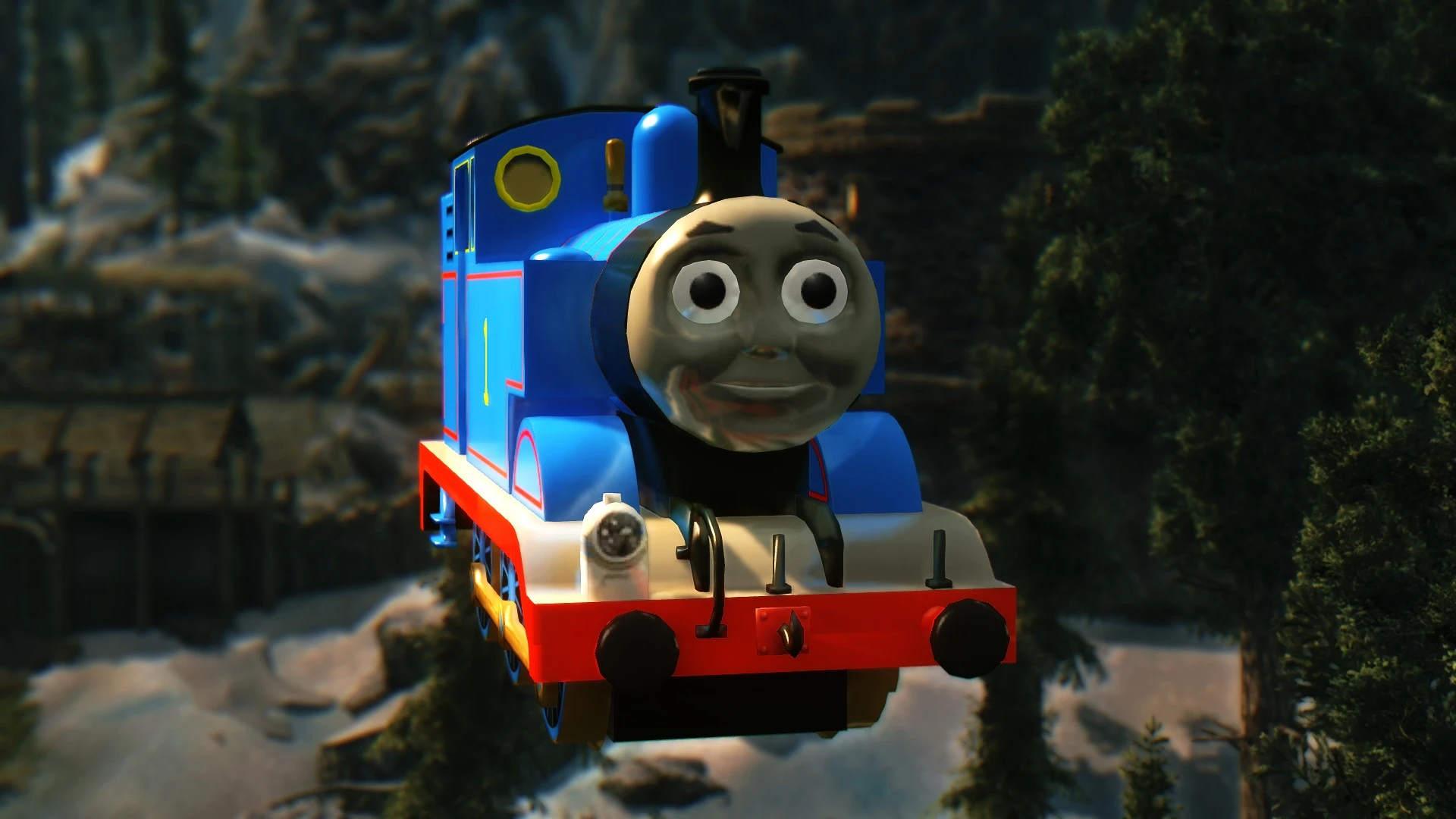
At some point, Bethesda noticed that the modding scene for Skyrim was drawing a massive amount of attention. Mods did all sorts of things, from silly things like transforming dragons into Macho Man and Thomas the Tank Engine to adding new quests and characters to the game. Surely, Bethesda thought, there must be a way to harness the fans’ fervent energy to generate even more revenue for their company.
If Macho Man isn’t your thing, maybe you would rather replace the dragons in Skyrim with Thomas the Tank Engine, the destroyer of worlds?
However, Bethesda fumbled this opportunity. What Bethesda didn’t understand was that mods were popular because they were by fans, for fans, for free. When they tried to launch their Creator’s Club program in 2017 to (effectively) monetize mods for Fallout 4 and Skyrim, the community turned against them. The most popular mod available for Fallout 4 through the Creator’s Club system had one function: to remove the Creator’s Club from the game. The system was an utter failure.
Even so, Bethesda made the wise decision to let their fans continue to make and distribute mods outside the Creator’s Club. They were unable to directly monetize mods, but even today, they still passively benefit from the attention that mods bring to their games.
Valve: “Here are some tools. Go nuts.”
In contrast to Bethesda, Valve understood that the best way to take advantage of mods and fan games is to support their development while taking a hands-off approach. When Valve created the Source engine for games such as Half Life 2, Portal, and Team Fortress 2, they made the engine and its developer tools available to the community through Steam. They also added integration with Steam so that creators had an easy way to distribute their mods and standalone fan games. Then they took a step back and waited.
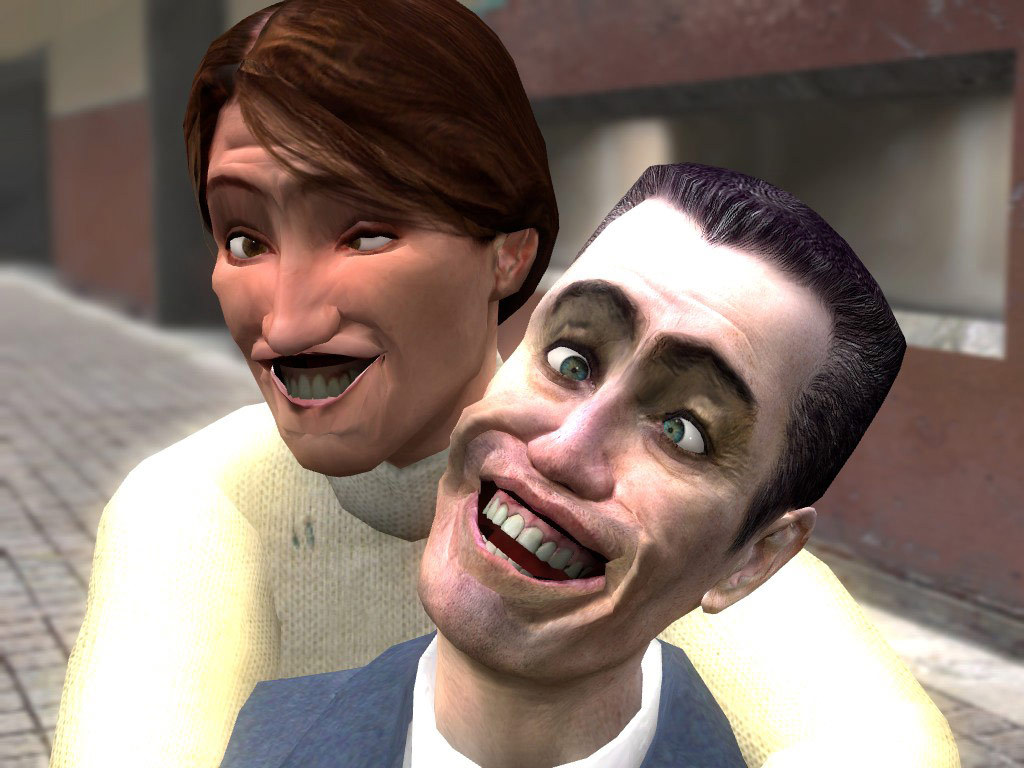
Garry’s Mod is a mod that turns Valve’s Source engine into a physics sandbox.
The results were astounding. Garry’s Mod, a standalone game/mod that turns the Source engine into a physics sandbox, took the world of PC gaming by storm. The experimental narrative game, The Stanley Parable, was originally released as a mod for Half Life 2, and after receiving critical acclaim, it was remade from the ground up in the Source engine and released as a standalone game. Black Mesa, the “fan-made re-imagining of Valve Software’s Half-Life,” expands upon Valve’s original groundbreaking game and is for sale on the Steam store. With little effort, Valve reaped massive rewards by supporting their community’s mods and fan games.
Nintendo: “Don’t even think about it.”
At the totally opposite side of the spectrum from Bethesda and Valve, we find Nintendo. Despite their friendly appearance, Nintendo is extremely territorial about their intellectual properties and shuts down any fan projects that infringe on their copyrights. A few notable casualties of Nintendo’s wrath include the following:
AM2R (Another Metroid 2 Remake), an unofficial remake of the 1991 Game Boy game Metroid II: Return of Samus, was shut down after Nintendo sent a DMCA takedown notice to the creator.
Project M, a popular mod in the tournaments for Super Smash Bros. Brawl, ceased development after Nintendo threatened legal action against its developers and tournaments that livestreamed gameplay of the modified version of the game.
Super Mario 64 Online, a mod for an emulated version of Super Mario 64 that adds online multiplayer to the game, was issued a cease and desist order less than a day after its launch.
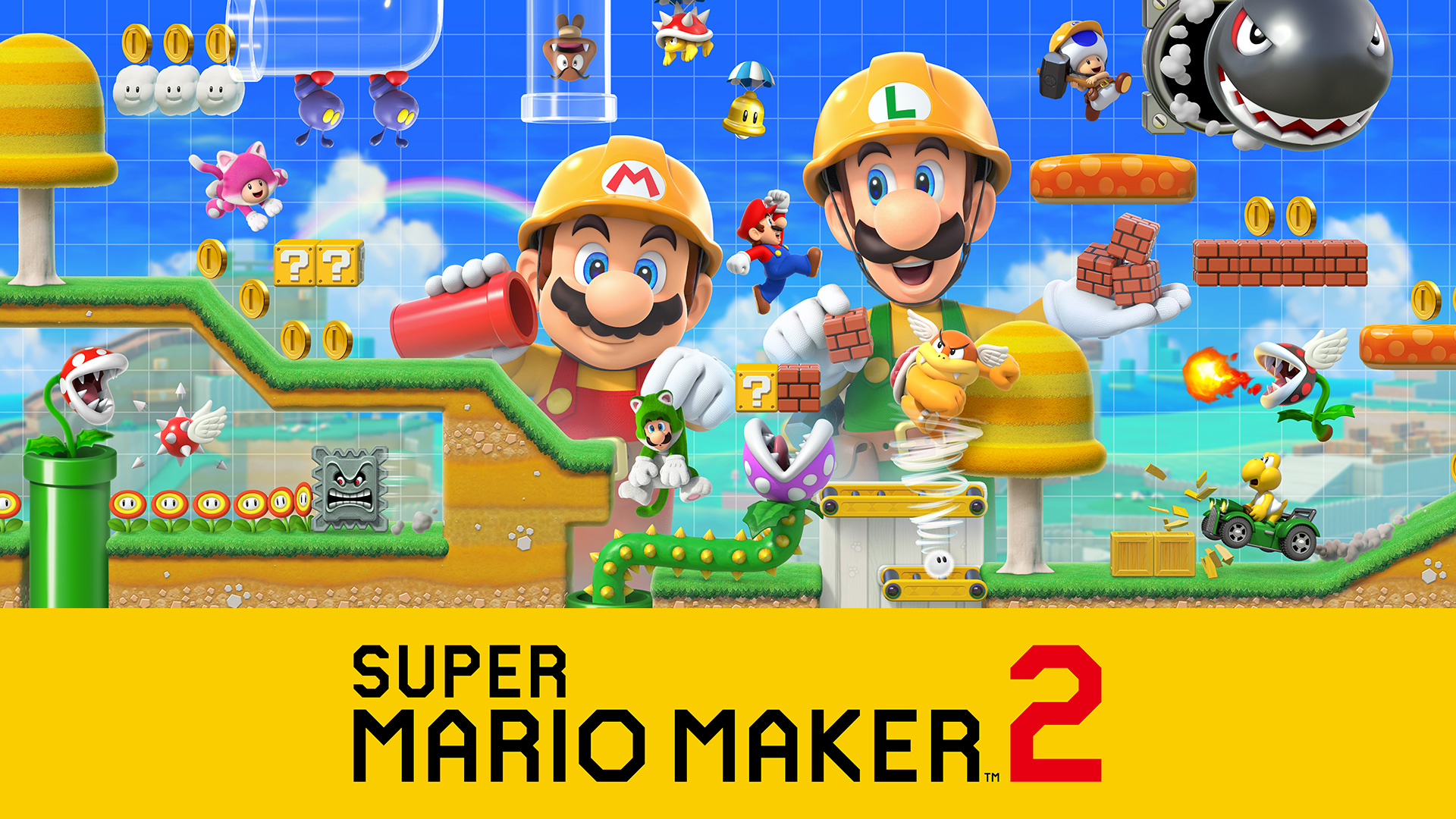
These are just a few examples. Nintendo has issued hundreds of cease and desist notices to loyal fans, and in more serious cases, issued lawsuits totaling millions of dollars for counterfeit trademarks and copyright violations. Not long after a purge of websites hosting pirated copies (known as ROMs) of classic Nintendo games, Nintendo released Super Mario Maker 2. This game allows players to express their creativity with Nintendo’s classic Mario series, but it still doesn’t grant the freedom that was offered by directly modifying the ROMs of older Mario games.
Rather than allowing mods and fan games, Nintendo tightly controls the avenues fans can use to make content related to Nintendo properties.
At least Nintendo makes their message abundantly clear: they don’t want anyone else touching their intellectual property for any reason. Everything related to Nintendo must remain tightly under Nintendo’s control and provide their pure, carefully crafted, Nintendo experience.
Concluding Thoughts
While I understand the need to protect copyrights, I personally feel that Nintendo’s view towards mods and fan games is unnecessarily hostile. Instead, I look at Valve as an example for how to support excited fans and benefit both sides simultaneously. Mods and fan games inevitably exist in a gray area where copyright laws have trouble defining what is and is not acceptable. It is up to developers and publishers to decide how they will address their fans’ passion projects, and for the benefit of everyone, I hope that more developers and publishers will embrace their fans who want nothing more than to support the games they love.
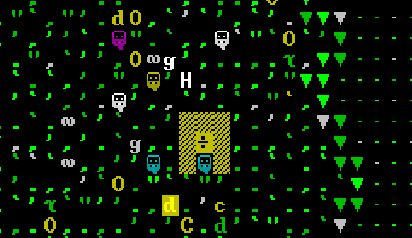
The legendary fantasy world simulator, Dwarf Fortress. Bask in the pure authenticity of its ASCII graphics.
Should games stay true to their iconic elements that we fall in love with? Or should games be more inclusive even at the cost of what their die-hard fans love most?
Monster Hunter Woes
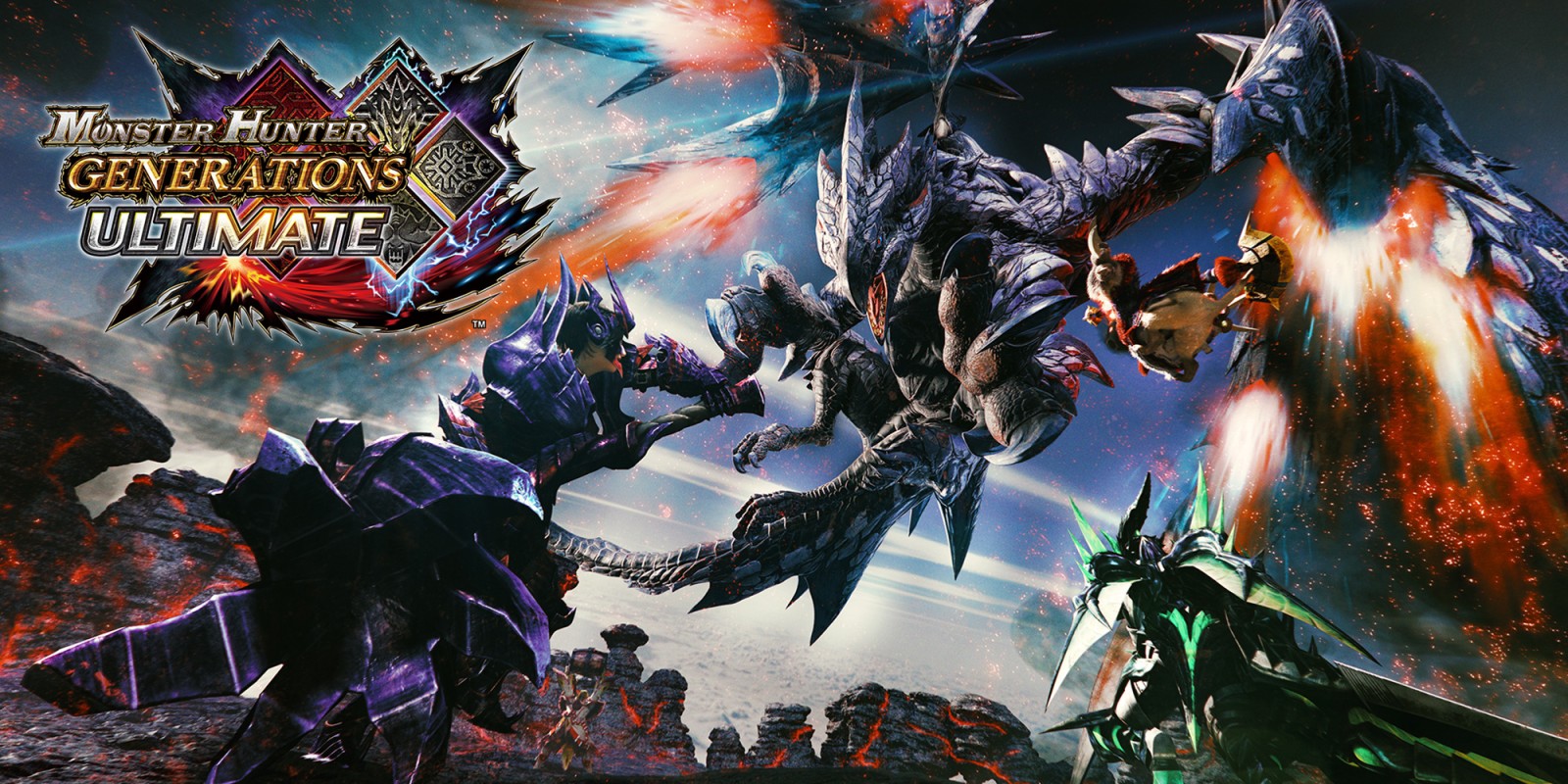
Last time I wrote on this blog, I discussed my first ever experience playing a game in the Monster Hunter franchise. To briefly summarize, I played Monster Hunter Generations Ultimate, which was the last game in the franchise before the series was “casualized” for broader Western audiences with Monster Hunter World. My first experience with MHGU was one of frustration and agony: the game is front-loaded with hours of menial gathering quests and tedious tutorials, and when you finally get to fight monsters, your hours of mushroom gathering do nothing to help you.
To address the poor new player experience as well as many unintuitive aspects of the franchise, Capcom released Monster Hunter World. While this game streamlines the Monster Hunter experience and appeals to a wider audience, many of the original fans of the series are, to put it nicely, disappointed. MH World’s current roster of 36 large monsters pales in comparison to MHGU’s whopping 93 large monsters. Additionally, many iconic armor and weapon designs were either simplified or removed entirely in MH World.
And yet, despite all this, Monster Hunter World is the best-selling title in Capcom’s 40-year history. So, who’s correct? Unless you’re a business executive at Capcom, there’s no clear cut answer.
Authenticity: Cult Classics for a Reason
Many games need to lean heavily into the authenticity of the franchise. It is no exaggeration to say that many games would entirely lose their appeal if they tried to reach a wider audience. The Dark Souls series is famous in mainstream media because of its uncompromising difficulty, and it is even responsible for creating the “Souls-like” genre of uncompromisingly difficult games that punish you for dying. Other lesser-known franchises such the Touhou bullet hell series (video shown below) have such high barriers to entry that only the most dedicated players even stand a chance at completing the game.
Accessibility: Let Everyone Play
Other games try to be as accessible as possible. These games consistently reach larger audiences by smoothing out the experience to appeal to everyone. Consider the most recent additions to the longstanding Pokémon game series: Pokémon Sword and Shield. These games are designed to appeal to kids who have never played a Pokémon game as well as veterans who first played Pokémon over 20 years ago, so accessibility is top priority. These games received a lot of criticism for their lack of innovation and terrible online functionality, but they still broke Nintendo sales records and were responsible for massively boosting sales of the Nintendo Switch console. The developers at Game Freak probably figure, “Hey, we have a formula that works, why change it?” From a business perspective, it’s hard to argue with them, but longtime players of Pokémon games might be disappointed with how little fresh content there is to experience.
For better or for worse, Pokémon Sword and Shield stick to the same old Pokémon formula we’ve seen for years.
By the way, you could make a counterargument that the authentic Pokémon experience was designed for kids and prioritizes accessibility over almost anything else. However, if you go back to the roots of the franchise with the original Pokémon Red and Blue games on the Game Boy, I think you will find that these games are far more difficult and convoluted than recent entries in the series. Therefore, my point remains that the newer Pokémon experience is far more accessible than the “authentic” Pokémon experience of the older games.
Smashing Revelations
Rarely, there are some franchises that try to walk the thin line between staying true to the feel of the original games while keeping the series accessible to everyone. This is the case for the Super Smash Bros. game series, and with each entry, we can clearly see how the developers tried to both appease fans of the original games while keeping the game accessible to newcomers.
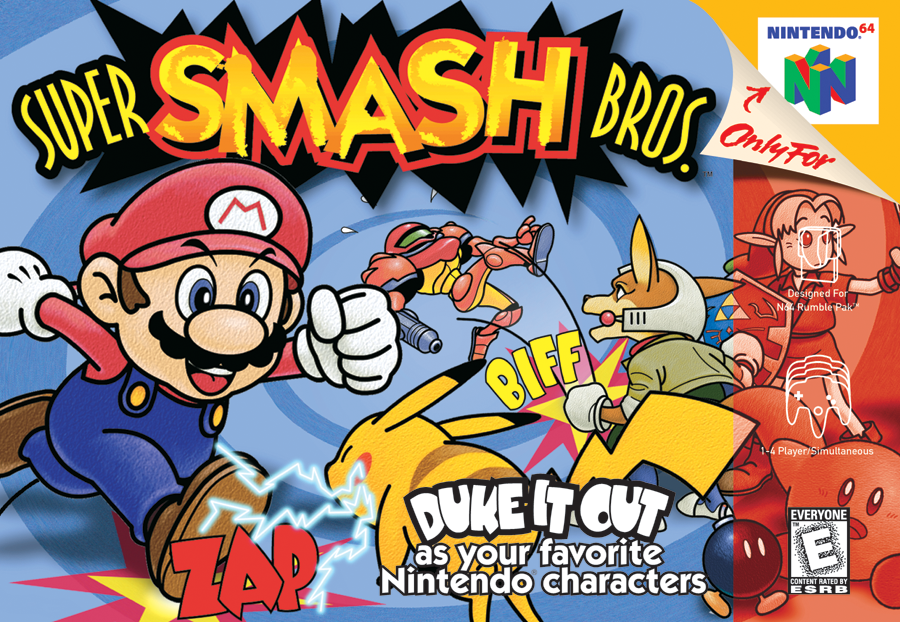
The original Super Smash Bros. was released for the Nintendo 64 in 1999. The director, Masahiro Sakurai, wanted to create a fighting game that was fun for fighting game enthusiasts such as himself but was still approachable for players who were unfamiliar with fighting games. The result was a unique blend between traditional 2D fighters and 2D platfomers that featured a simple control scheme but a high skill ceiling.
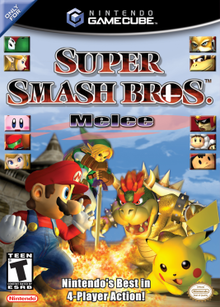
The sequel, Super Smash Bros. Melee, was released on the Nintendo Gamecube in 2001. This game featured faster gameplay with a much higher skill ceiling, and as a result, it accidentally fostered a cult following that still plays the game competitively nearly 20 years later.
However, the lightning quick gameplay (as shown in the video above) made the game inaccessible for new players. As a result, the game still struggled to find a broad audience.
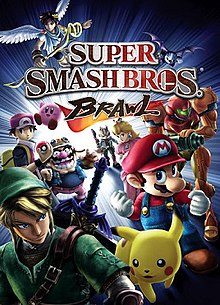
The next game, Super Smash Bros. Brawl, was released on the Nintendo Wii in 2008. To address the accessibility issues present in Melee, this game deliberately slowed down the gameplay and added random elements such as tripping to make the game more friendly to casual players. By trading authenticity for accessibility, these changes made Brawl the most successful entry in the series so far, but it alienated the players who enjoyed the competitive feel of the original games.
After Sakurai noticed that many hardcore fans still played Melee instead of Brawl, he designed Super Smash Bros. for Wii U (released 2014) to exist somewhere between the extreme speed of Melee and the casual pace of Brawl. This game was well received, but at this point, the damage had been done. The Melee players were committed to their game, and they hadn’t forgotten how they were betrayed by Brawl. The Melee players stuck with Melee, but newer players happily moved from Brawl to Wii U and found its faster gameplay exciting.
At last, in 2018, Super Smash Bros. Ultimate on the Nintendo Switch tried to live up to its name and bridge the great divide in the Smash community. This game features fast gameplay that appeals to the Melee players, and it also uses an input buffering system that ensures less experienced players can play at the faster pace without being frustrated by mistiming their inputs. This game had great reception overall: Wii U players saw it as a strict upgrade to their preferred game, and Melee players conceded that the game was at least fun to play. However, it still wasn’t enough to unify the community. To this day, Melee and Ultimate are both played competitively in separate tournament brackets. Despite his best efforts, Sakurai could not totally appeal to players on both sides of the authenticity versus accessibility spectrum. Could he have done anything better?
There’s No Right Answer
While you can easily point to Brawl as the wedge that split apart the Smash community, you can’t say that Brawl was a mistake. The game was a massive commercial success, and it led to later entries that newcomers to the franchise absolutely loved. However, this came at the cost of permanently alienating the original fans of the game series that helped it get off the ground.
So, what’s the right answer? Should game franchises prioritize authenticity or accessibility? Honestly, I’m not sure. Shooting for accessibility certainly seems like the better option from a business perspective, but building a good rapport with your game’s community is equally important. Ultimately, the best advice I can give is that game designers should keep both perspectives in mind when designing their games.
I love Monster Hunter Generations Ultimate, but my first experiences with the game were brutal. This is a tale of how to not make a good first impression on a new player.
Welcome to Monster Hunter
For a while, Monster Hunter was a game series that lived somewhere on the fringe of my sphere of interest. Cool swords and flashy armor? Hell yeah. Fighting big, scary monsters that look like dinosaurs crossed with monstrosities from Godzilla? Hell yeah.
Doing all this on a 3DS with a tiny 3.5-inch screen that gives me headaches and a casing that makes my wrists spasm after an hour or two of holding it? Eh… maybe not.
Despite Monster Hunter sounding like an awesome game in theory, I was turned off by the fact that the versions I knew about were only released on handheld consoles. I used to love playing games on my Gameboy Advance and Nintendo DS Lite in years gone by, but Monster Hunter just sounded like it needed something bigger than a handheld console to reach its full potential. If I was going to fight giant monsters, I wanted to see them in all their glory on a large screen so I could lean back on a couch and comfortably battle to the death for hours on end.
Thus, Monster Hunter floated quietly around my subconscious, until suddenly…
Monster Hunter World was released. This was the first major Monster Hunter game in a long time that was designed for non-handheld consoles. It was prettier, sleeker, and more accessible than any entry in the series before it. It seemed this was the game I was waiting for.
My Monster Hunter-obsessed girlfriend, however, disagreed. She bemoaned the fact that this game was ditching its deliberately obtuse elements in favor of being “Westernized” for more casual audiences. Frequently, she launched into rants about how this new entry was ruining the Monster Hunter she loved and wasn’t a “true” Monster Hunter game.
And to prove it (and to celebrate our anniversary), she bought me my own copy of the previous Monster Hunter game for the Nintendo Switch: Monster Hunter Generations Ultimate. Thus began my very first foray into the “true” world of Monster Hunter.
Starting off on the wrong foot
Did you know this game was ported from the 3DS? Well, if I didn’t know ahead of time, I would have figured it out about ten seconds in.
After watching a flashy opening cutscene where four powerful hunters fend off a huge dragon, I was pumped. I pressed A to move past the title screen and was confronted by an ugly main menu featuring oversized, pixelated buttons that looked every bit like they belonged to the touchscreen of a 3DS. No problem, I thought, graphics aren’t important to me as long as the gameplay is fun. I decided to take a quick look at the options before diving in, so I flicked the left control stick to move the cursor from “New Game” down to “Options,” and realized that the cursor didn’t move.
What?
I flicked it a few more times. Nope, the cursor definitely didn’t move. Okay, did my controller disconnect? No, because I was able to press A to move past the title screen, wasn’t I? Can I not navigate the menu with the left stick like literally any other game in existence on any console?
Perplexed, I tried the right control stick, and lo and behold, the cursor moved. I tried the d-pad as well, and the cursor moved again. It didn’t take me long to figure out how to navigate the menu, but this short episode was all it took for me to lose all my hype and excitement about fighting monsters. All I could focus on was wondering why this game couldn’t just use the left stick for menus like any other game. I figured it was because the menus were supposed to be navigated with the 3DS touchscreen. However, this still made me nervous about what other sacred conventions this game would break.
Once I hit “New Game,” I was thrust into a character creation menu where a semi-nude male character model stood before me in all his low-poly glory. I could practically count every polygon on his model. When the camera zoomed in to look closely at his face, I could even count the pixels in the texture that covered what few triangles made up the surface of his face.
At this point I started to get nervous. I really wanted to like this game. It was a gift from my girlfriend to celebrate our anniversary, after all. Plus, I had always wanted to play a Monster Hunter game. The conditions could not be any more favorable for this game to pull me in, but I was no longer excited to play. It seemed like the game was doing everything it could to turn me away, and I hadn’t even really started the game yet. If I didn’t have my own strong reasons for playing, I might have quit right here. But I was determined, so I took a deep breath and started making my character.
I realized that this character customization system was very limited, so I settled on something simple and not-so-serious. I chose the smarmiest expression available and accented the smirk with a neon pink mustache. To match the mustache, I dyed the hair neon pink and put it in an exotic samurai hair tie. Then, I set my character’s skin to be as orange as possible, like he took a bath in orange juice as a healthier alternative to getting a spray tan. I named my flamboyant avatar Big Mama, and I set out to make all the men in the world of Monster Hunter swoon over Big Mama’s grace and beauty in battle.
Welcome to Mushroom Hunter
After slogging through the first several tutorial missions, any lingering excitement I had for the game had totally evaporated. I had been playing for about two and a half hours, and all I had accomplished during that time was cooking a few slabs of meat, collecting ferns, and mining some ore. And it’s not like I was taking my time, either. My girlfriend was sitting next to me from the beginning, eagerly pointing to areas of the map where I could find the next item in a long grocery list that I had to gather. She kept insisting that the game starts slow, but it gets much, much better. I believed her and did my best to power through the early game fetch quests, but I could feel my life energy draining with every mushroom I picked.
If my girlfriend hadn’t been sitting with me throughout the entire start of the game, I would certainly have quit the game here and never looked back.
But I stuck with it for her sake as well as mine. I wanted to share my girlfriend’s hobby with her, and I wanted to fight big monsters, damn it. I was playing Monster Hunter, right? There were monsters around here somewhere. I just had to stick with it until the game decided I was finally worthy of fighting something. I had noticed that the controls felt clunky and slow, so maybe this was the game’s way of making sure I was used to the controls before it threw a demanding challenge my way. I held onto this sliver of hope as tightly as I could.
Let me play the game already
I had a distinct feeling that what I was doing, gathering endless resources while little animals harassed me for invading their favorite mushroom gathering spot, was not Monster Hunter. The real Monster Hunter hadn’t come yet, and surely I was still in tutorial land. But after eight hours of gathering and reading endless tutorial text boxes brimming with puns, I had all but run out of patience.
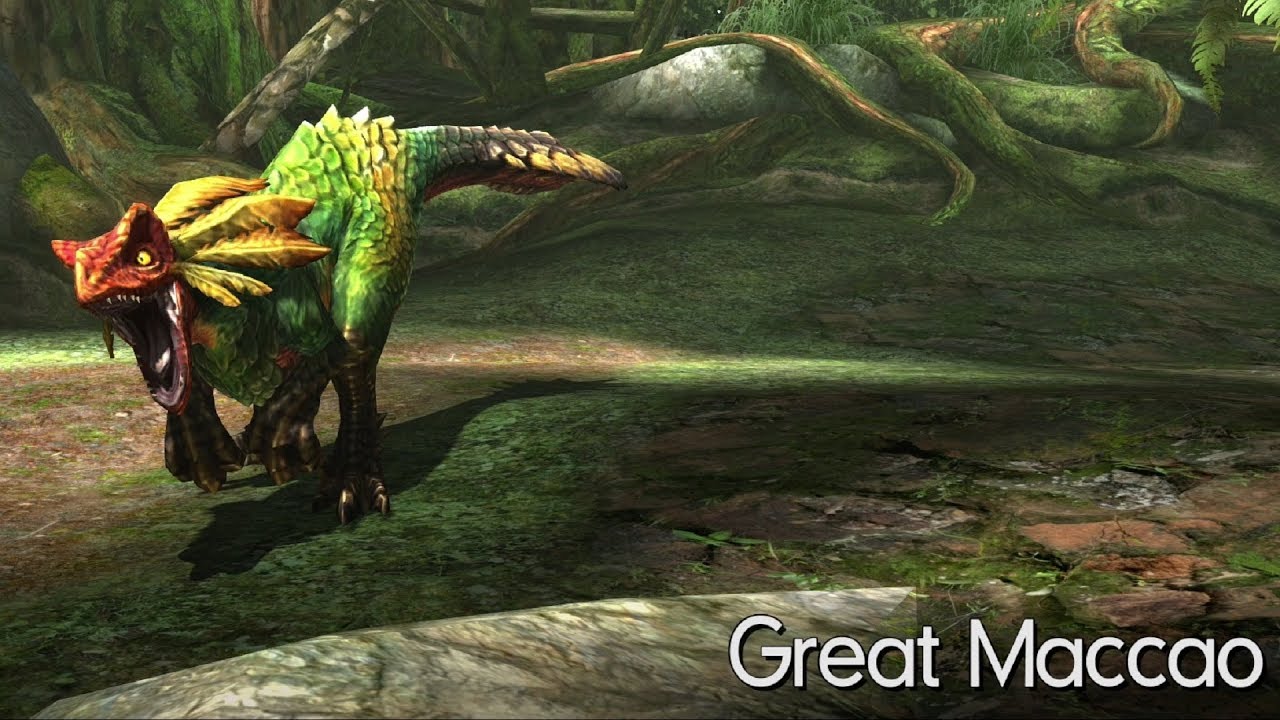
It was when I was about to quit for the night when something finally caught my eye: a hunting quest appeared! And this wasn’t a quest for hunting a bunch of little guys; this was a real, honest-to-God hunting quest for a Great Maccao, a creature larger than Big Mama! I was ecstatic and jumped right into the quest.
After eight grueling hours of gathering quests, I wasn’t about to take my time getting to know the Great Maccao before fighting it. I sprinted around the map until I found the bird-dino and ran towards it fearlessly. I was in a frenzy. Big Mama wanted bloodshed.
And to be fair, I got my wish. Blood was certainly shed. Not the Great Maccao’s, though. After my leaping strike got struck down for the eighth time in a row, I started to realize that this wasn’t the kind of game where you could just rush in at the enemy and rely on quick reflexes to get you out of danger.
Every move I made had to be extremely deliberate. Moving towards or away from the enemy. Drawing or sheathing my weapon. Dodging out of the way. Drinking a health potion. Even pressing an attack button. Every action you can think of has a long, uninterruptible animation that you have to be sure you have time for before you do anything at all. Oh, what’s that? You thought you had enough time to heal before the monster charged at you? Well, tough luck buddy, you forgot that your character had to flex for one and a half seconds after drinking the potion, so you got hit again. Now your health is low and you need another potion. Try to be more careful this time.
Once I started to understand the flow of combat, I felt increasingly frustrated with the game. You know what I would have appreciated instead of doing all those gathering quests? How about tutorials that teach you how to safely attack, dodge, and find time to drink potions? Teaching major combat game mechanics in the tutorial? Wow, what an incredible addition that would be.
After a grueling 25 minute battle, I finally took down the Great Maccao. I triumphantly stood over its head and started carving pieces from it to use for making weapons and armor. Somehow, I carved a tailspike from its head along with a scale and a piece of hide, and I couldn’t carve anything else off the rest of its body. Whatever. I was exhausted and just wanted to bask in the glory of my first successful hunt.
After receiving quest rewards and making my way to the smithy, I had a hard realization. I couldn’t make any new gear. I had one tailspike, but I needed two for my new weapon, and the armor set I wanted to make required at least four times the Great Maccao parts I currently had.
Something clicked in my mind. Grinding. That’s what the tutorial was trying to teach me. Hours of collecting resources were not meant to teach me combat mechanics. They were conditioning me to grind.
And as that thought clicked into place, the rest of my mind shattered. I let out a primal cry as nine hours of sheer frustration and exhaustion culminated to seemingly nothing. There was no satisfaction. My fight with the Great Maccao ended as a Pyrrhic victory. I retired to bed for the night and cried myself to sleep.
Welcome to Mushroom Hunter?
After a full night’s rest (and plenty of time to rant to my girlfriend about how awful the new player experience is in this game), I felt rejuvenated enough to continue where I left off. Fortunately, the fight with the Great Maccao was the barrier to the next level of quests. There were still lots of gathering quests to do, but these were interspersed with other hunting quests for large creatures. None of them were that terrifying, especially after I figured out how the combat system worked, but they were entertaining and varied enough to hold my attention. At least I could finally enjoy playing the game.
Fast forward a few days of dedicated playing. I reached 3-star rank (tier 3) quests, put about 30 hours into the game, and only recently finished making my first full set of armor from Great Maccao parts. I noticed a suspicious entry in the quest list for a gathering quest. The description read:
I’ve run out of Abyssal Mushrooms for my research. Could you pick some for me? There’s been talk about odd, blade-sharpening sounds coming from deep in the forest, but I’m sure you’ll be fine! -Wycademy Mycologist
It was another mushroom gathering quest, but this description was clearly different from everything I had seen thus far. I was keenly aware of the “DANGER” symbol in the description. I stocked up on battle supplies before heading out for this perfectly normal mushroom gathering quest.
Welcome to Monster Hunter!
To my surprise, rather than starting me in the safety of the base camp, this quest dropped me directly into a deep area of the map. Before I realized what was happening, I was face-to-face with a terrifying, fire-breathing, T-rex-like monster: Glavenus.
This lad was far bigger, faster, and scarier than anything I had come across, and for the first time, I felt that I was totally out of my league. I tried my hardest to fight him, but he was far too strong. Half of my attacks reflected harmlessly off of his tough scales, leaving me completely open to a swing of his red-hot tail that nearly killed me in one hit. After battling desperately with this beast for 45 grueling minutes, I realized that the 50-minute time limit for the quest was almost up. I had no choice but to retreat and deliver the eight mushrooms I had collected at various intervals when I ran away to heal.
Although having to retreat was somewhat unsatisfying, I finally felt that I had truly experienced Monster Hunter. The pure adrenaline rush of coming up against a terrifying foe for the first time, the feeling of being totally overwhelmed by the monster’s ferocity, and the pure satisfaction when you learn its behaviors and outsmart it—these are the hallmarks of Monster Hunter that make it great. I finally understood the thrill of the game, and I couldn’t wait to play more.
I just wish I didn’t have to play for over 30 hours before I could truly experience the game.
Less Mushrooms, More Monsters
I share this story for two reasons: it’s entertaining (or at least I’d like to think so), and it speaks volumes about the importance of making a good first impression and providing a positive new player experience. Fortunately, I was determined enough to stick with Monster Hunter Generations Ultimate to push through the awful new player experience, but I can imagine many players would have quit. Therefore, I would like to wrap up this cautionary tale with a few lessons for developers that I learned the hard way as a player:
1. Put the awesome first
Is your game awesome? Great! Let me experience it now. If I can’t experience what makes your game awesome in the first five minutes, then chances are good I’m not going to get hooked. Monster Hunter Generations Ultimate was lucky; I was determined to enjoy this game. But most players don’t have the determination to slog through hours of terrible exposition and tutorials before finally reaching something compelling. Less mushrooms and more monsters at the start of the game, please.
2. Don’t reinvent the wheel
Sometimes, you don’t need to try too hard. Stealing ideas and following common conventions can be a good thing. This is especially true when it comes to UI design. Imagine if every game had a radically different UI from anything that had ever been done before. There would be so much new information to process when starting the game for the first time that it would be totally overwhelming! People have already researched solutions to most of the design challenges you will face, so make sure to look for these common solutions and don’t be afraid to recycle them.
3. Graphics aren’t everything, but they make strong impressions
I have always been a strong proponent of the mindset that graphics don’t matter as long as gameplay is fun. I still adhere closely to this idea, but I admit that graphics do serve a critical role in making first impressions. If your game doesn’t immediately start with something compelling, you had better make sure it is at least easy on the eyes. The ugly UI and low-poly models presented at the start of Monster Hunter Generations Ultimate made the slow start unbearable. I still argue that the game should have started with me fighting a monster, but I could forgive a slower start if it at least gave me something pretty to admire.
4. Let me jump in the deep end of the pool
Admittedly this can be a bit tricky to implement depending on the game, but sometimes players don’t need all the tutorials and starting levels to acquire the skills they need for later in the game. Maybe they’re quick learners, or maybe they’re veterans of the franchise or genre. Whatever the case may be, letting players skip the tutorial and jump directly to the more compelling parts of your game will hook players much more effectively than forcing everyone to experience your long tutorial sequence (I’m looking at you, Pokémon). Just make sure that players have the option to go back to the tutorials if they want to.
An elegant and famous example of this is the use of warp zones in the original Super Mario Bros. for the NES. Players who were familiar and skillful enough with the game could take these shortcuts to skip entire worlds and get to harder levels without replaying the entire game each time. Features like these are great for both new players and veterans alike.
5. Show me, don’t tell me
There is nothing more frustrating than constantly being interrupted by long textboxes explaining what you need to do. Now, I’m not saying there’s no place for textual instructions in games. I believe the most efficient method to convey accurate and concise information to a player is through text. However, text should be used sparingly, and only when a point really needs to be emphasized. If you can teach a player a mechanic through gameplay, you should.
6. Never underestimate the power of community
Monster Hunter is a unique series in that its multiplayer features are purely cooperative, and this system fosters a positive community that wants to introduce more people to the Monster Hunter franchise. I can confidently say that I would never have stuck with Monster Hunter Generations Ultimate if my girlfriend had not introduced me to it and stuck with me through the long slog at the start of the game. If you know your game is difficult to get into, make sure you support your community. They’ll help you out.
Final words
I love Monster Hunter Generations Ultimate. But based on my experience, would I recommend people try it? Honestly, if you’re totally new to the franchise, no. Play Monster Hunter World if you’re curious—I’ve heard the new player experience is much better in that game. But if you’re a fan of Monster Hunter World, a fan of the older games, or you have a friend who is a fanatic, then sure, give it a shot. Just make sure you know what you’re getting yourself into.










 Kevin Stiles' Game Design Blog